Aigerim Kalikova
Senior-lecturer, aigerim.kalikova@astanait.edu.kz, Astana IT University, Expo, C1 block, С1.3.335

“Computer Networks: Fundamentals and Principles of Operation” is an introductory course designed for first-year students. The course provides a basic understanding of how computer networks are organized, how network devices communicate, and how data is transmitted from one device to another. Students will explore the fundamental concepts and technologies used in modern computer networks.
The course covers network interfaces, Ethernet, LAN, network topologies, switches, MAC addresses, IP addresses, IPv4, subnet masks, routers, default gateways, DHCP, NAT, network ports, IPv6, and the basic principles of the OSI and TCP/IP models. Students will also learn the main differences between TCP and UDP and understand how different network protocols work together.
Throughout the course, students will analyze practical network scenarios and trace the path of data between devices. By the end of the course, students will be able to explain how a device communicates within a local network and how data reaches a remote server through switches, routers, and the Internet.
This course is intended for first-year students and does not require advanced knowledge of computer networking. Students should have basic computer literacy and a general understanding of how computers and operating systems work.
Basic knowledge of IP addresses, computer hardware, and command-line interfaces may be helpful but is not required. The course introduces networking concepts from the fundamentals and gradually develops students’ understanding through examples, demonstrations, and practical tasks.
Senior-lecturer, aigerim.kalikova@astanait.edu.kz, Astana IT University, Expo, C1 block, С1.3.335

Senior-lecturer, kamshat.asmaganbetova@astanait.edu.kz, Astana IT University, Expo, C1 block, С1.3.335
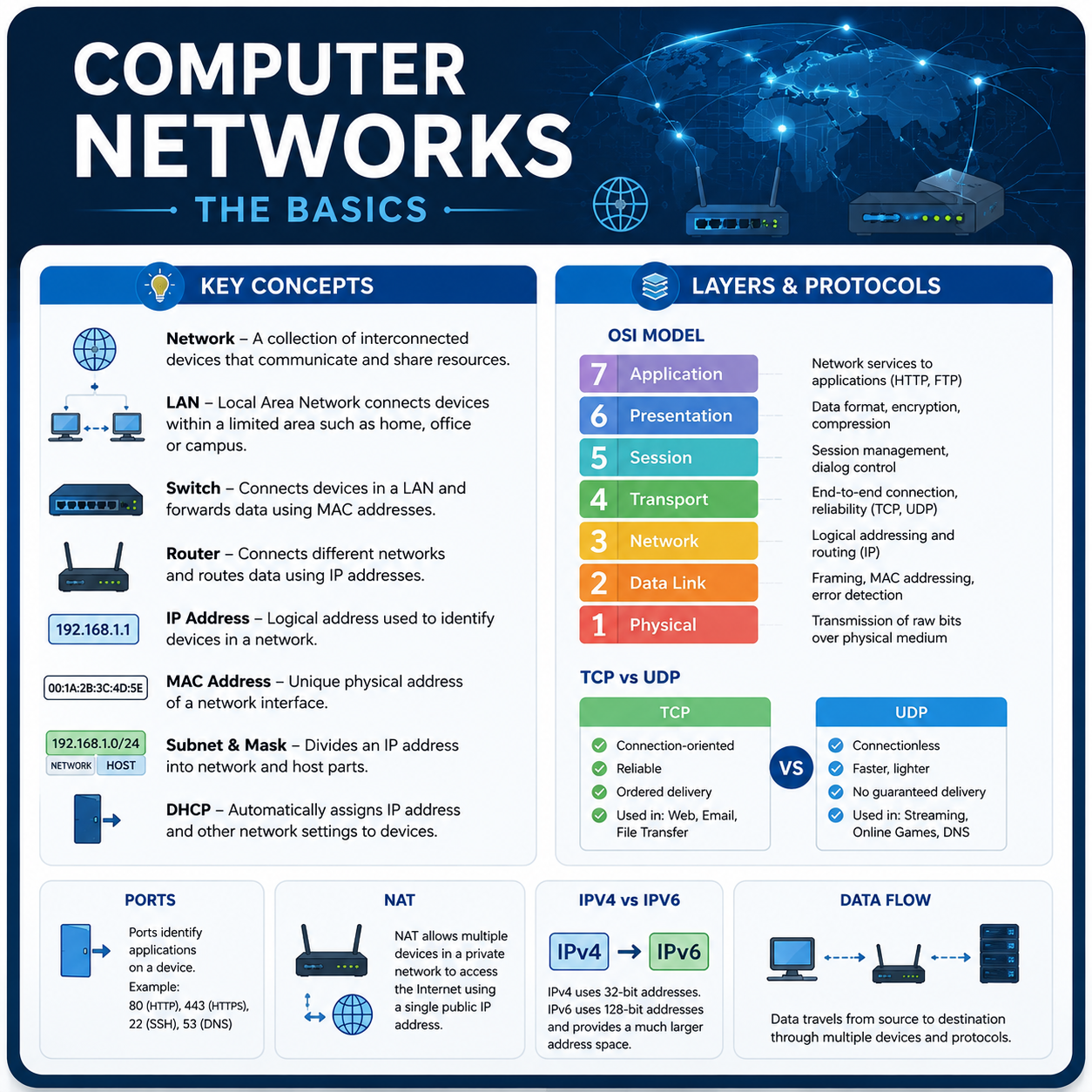
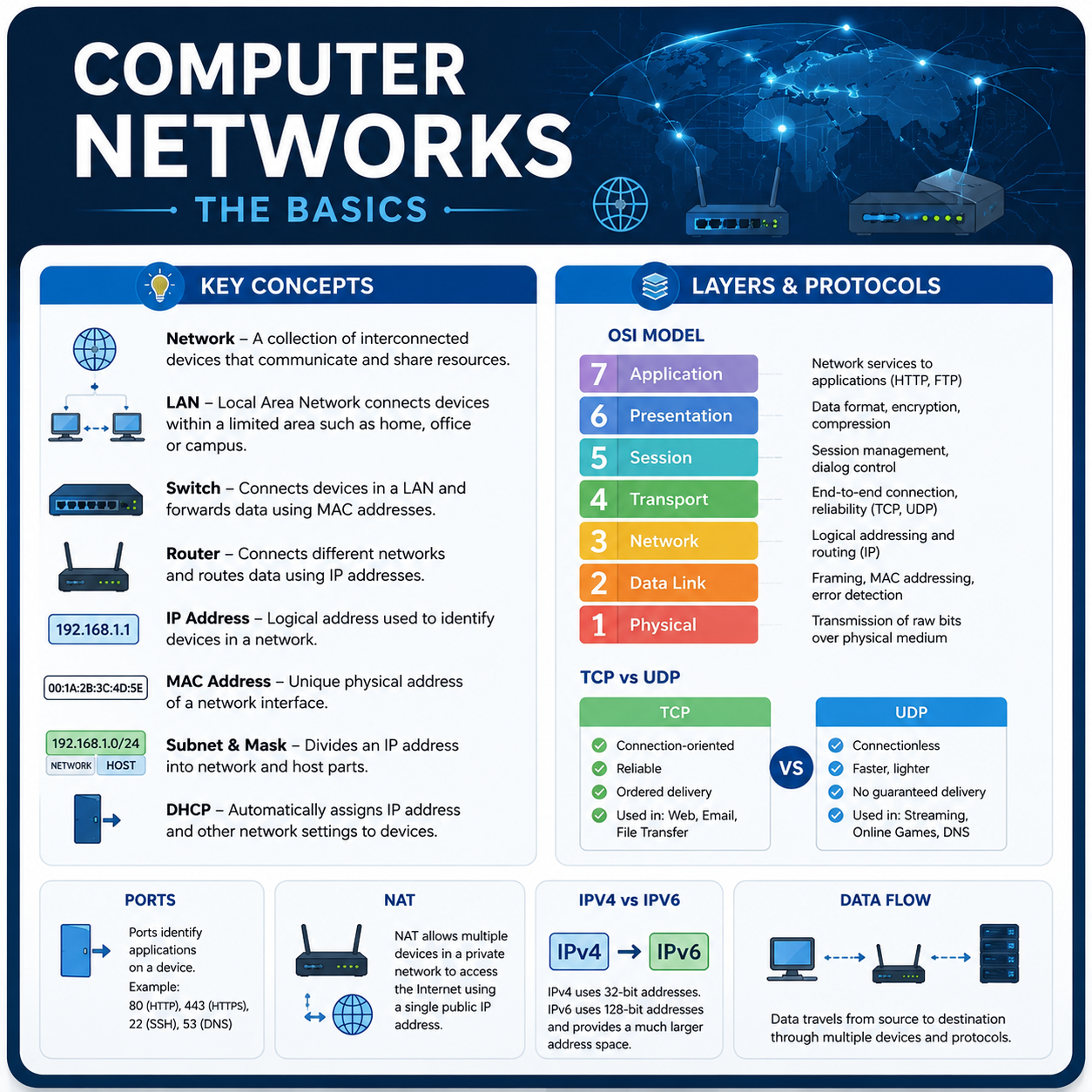
A computer network is a group of interconnected devices that communicate with each other to exchange data and share resources. Examples include home networks, university networks, corporate networks, and the Internet.
A switch primarily connects devices within the same local network and forwards Ethernet frames using MAC addresses. A router connects different IP networks and forwards packets between them using IP addresses.
A MAC address is used primarily for communication at the Data Link layer within a local network. An IP address provides logical addressing and allows devices to communicate across different IP networks.
DHCP (Dynamic Host Configuration Protocol) automatically provides network configuration parameters to devices, including an IP address, subnet mask, default gateway, and DNS information.
TCP provides reliable, connection-oriented data delivery, while UDP has lower overhead and does not provide TCP-like reliable delivery. UDP can be useful for applications where low latency is important, such as voice and video communication.
A network port identifies a specific application or service on a device. Common examples include HTTP on port 80, HTTPS on port 443, SSH on port 22, and DNS on port 53.
NAT (Network Address Translation) allows devices using private IP addresses to communicate with external networks through translated addresses. It is commonly used in home and organizational networks to provide Internet access to multiple devices.
You will learn the fundamentals of computer networks, including LAN, Ethernet, MAC and IP addressing, subnet masks, switches, routers, DHCP, NAT, network ports, TCP, UDP, IPv4, IPv6, and the OSI and TCP/IP models.